Home | english | Impressum | Sitemap | KIT

Subjects


1

Research of Prof. Dr. Peter W. Roesky

Institute of Inorganic Chemistry, Karlsruhe Institute of Technology (KIT), Engesserstr. 15, 76131 Karlsruhe
Tel: +49-721-608-46117, E-Mail: roeskyJsx3∂kit edu


1. Lanthanides: Coordination Chemistry, Catalysis, Materials


Coordination compounds of the lanthanides show versatile catalytic, structural, optical, and magnetic properties, which when compared with those of other elements in some cases fundamentally different. My current research interest is focused on inorganic chemistry of the lanthanides and the physical and chemical properties of these compounds. The research ranges from the structural chemistry of rare earth clusters (including crystallographic problems) and their application in material science to coordination chemistry and organometallic compounds. Besides working on synthetic and structural problems, my research interests are focused on the application of newly synthesized compounds. Thus, the physical properties of the cluster compounds, e.g. the magnetism, and the application of the complexes in homogeneous catalysis are investigated.             


                                      2


Research areas

a) New lanthanide amides as homogeneous catalysts

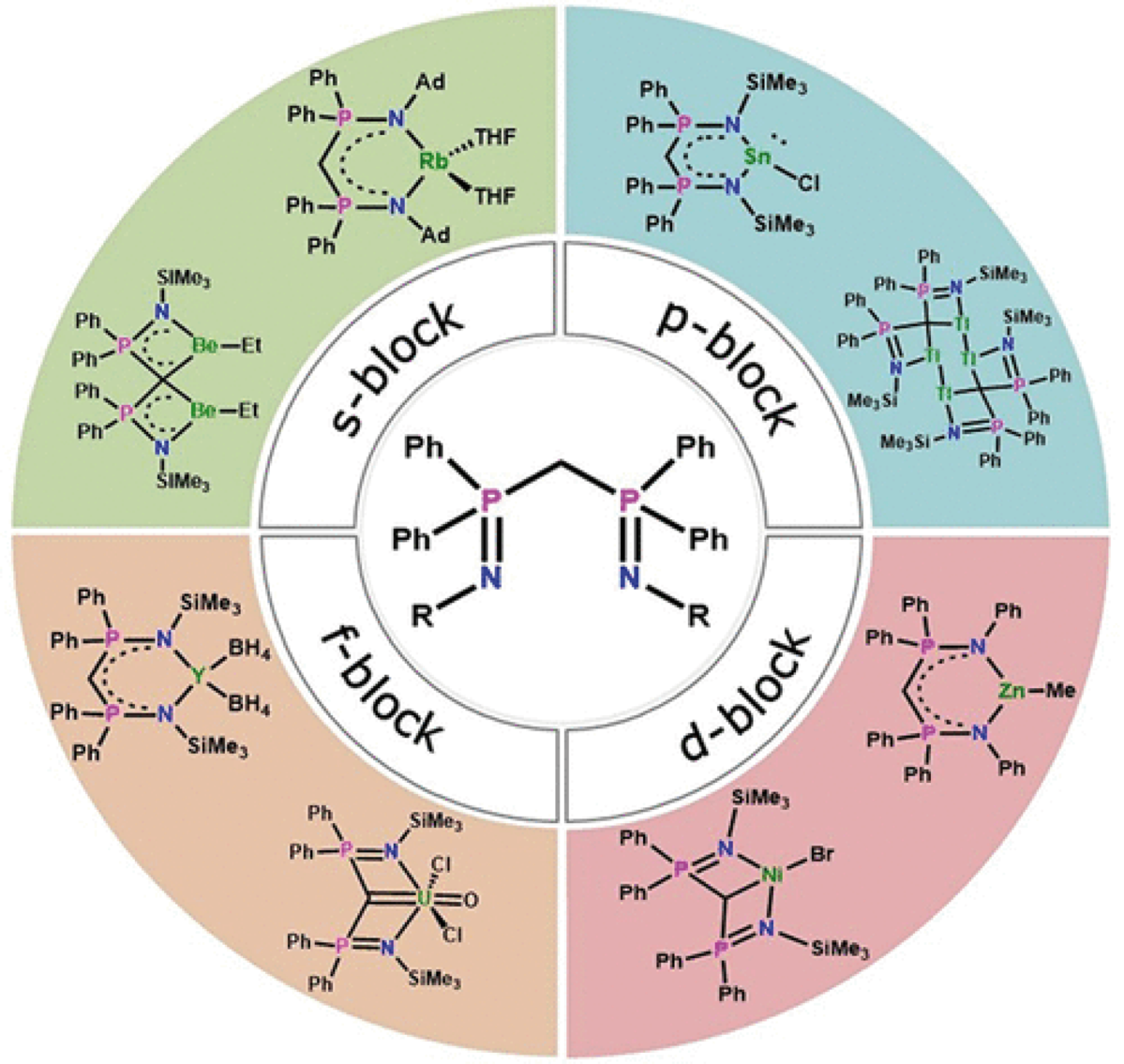
In this project we focus on the synthesis of new lanthanide complexes having organic and inorganic amides in the coordination sphere. Within this project we use chiral and achiral amides as ligands. P-N ligands are one group of compounds that has been intensively studied by us (Scheme 1).     


3

Scheme 1


By using ligands with different steric demands we were able to synthesize in controlled matter complexes in high yields with various substitution patterns. First, the complexes were structurally investigated. Then they are used for various catalytic transformations. One objective is the use of our compounds as catalysts for the intramolecular hydroamination / cyclization to give N-heterocyclic products (Scheme 2), which can be used as building blocks for the synthesis of biologically relevant molecules. Another application of our compounds is the use as catalysts for the polymerization of polar monomers to give biologically degradable polymers.


4

Scheme 2


a) M. Rastätter, A. Zulys, P. W. Roesky Chem. Commun. 2006, 874-876. b) M. T. Gamer, M. Rastätter, P. W. Roesky, A. Steffens, M. Glanz Chem. Eur. J. 2005, 11, 3165-3172. c) P. W. Roesky, M. T. Gamer, N. Marinos Chem. Eur. J. 2004, 10, 3537-3542. d) A. Zulys, T. K. Panda, M. T. Gamer, P. W. Roesky Chem. Commun. 2004, 2584-2585.


b) New materials: Synthesis of coordination oligomers and –polymers of the lanthanides – oxygen activation

The main topic in this area is the systematic synthesis of new coordination polymers and lanthanide oxygen clusters. As structural motives we observed chains, rings wheels, layers, and clusters (Figure 1). The magnetic and optical properties of the coordination polymers were also investigated. Moreover, some of the clusters can be used as catalysts for the O2-activation and also as model compounds for lanthanide alkoxide catalysts.


5  6

7

Figure 1


a) V. Baskar, P. W. Roesky Dalton Trans. 2006, 676-679. b) M. R. Bürgstein, M. T. Gamer, P. W. Roesky J. Am. Chem. Soc. 2004, 126, 5213-5218. c) P. W. Roesky, G. Canseco-Melchor, A. Zulys Chem. Commun. 2004, 738-739. d) M. R. Bürgstein, P. W. Roesky Angew. Chem. 2000, 112, 559-562; Angew. Chem., Int. Ed. 2000, 39, 549-551.


2. Zinc: Organometallics and Catalysis

In the beginning of our work in zinc chemistry we used ligands that we already had in stock from our projects of lanthanide chemistry. The zinc complexes were then used as homogeneous catalysts. Depending on the obtained results the ligands and thus the resulting zinc compounds are now optimized. 


Research areas

a) Amido Zinc Alkoxides – Models for the Carboanhydrasis

We investigated the copolymerization of CO2 with propenoxide and cyclohexenoxide to give the corresponding polyesters by using amido alkoxides of zinc as homogeneous catalysts. The CO2 activation works in a similar way as observed in the enzyme carboanhydrasis.


8

Figure 2


a) J.-S. Herrmann, G. A. Luinstra, P. W. Roesky J. Organomet. Chem. 2004, 689, 2720-2725. b) M. T. Gamer, P. W. Roesky Eur. J. Inorg. Chem. 2003, 2145-2148.

 
b) Hydroamination by using Zinc Catalysts

The new zinc-based catalyst, N‑isopropyl-2-(isopropylamino)troponiminate zinc methyl, [{(iPr)2ATI}Zn-Me] was used for the homogeneous intramolecular hydroamination reaction. [{(iPr)2ATI}Zn-Me] is distinguished by a number of practical advantages such as the particular functional group tolerance, good activity in the catalytic conversion of non-activated C-C multiple bonds and a relatively high stability towards moisture and air. The reaction was able to tolerate a multitude of polar functional groups including ethers, thioethers, and amides. It is also notable that access to seven-membered heterocycles was possible as well.


a) A. Zulys, M. Dochnahl, D. Hollmann, K. Löhnwitz, J.-S. Herrmann, P. W. Roesky, S. Blechert Angew. Chem. 2005, 117, 7972-7976; Angew. Chem., Int. Ed. 2005, 44, 7794-7798. b) M. Dochnahl, J.-W. Pissarek, S. Blechert, K. Löhnwitz, P. W. Roesky Chem. Commun. 2006, 3405-3407.


3. Chemical Efficiency

In this area we try to improve significantly the synthesis of known compounds. Thus, sodium and potassium cyclopentadienide were obtained in an optimized synthetic procedure. They were prepared in a one-pot synthesis directly by the reaction of alkali metals with neat dicyclopentadiene at elevated temperature. The new reaction procedure provides a much more convenient access to the products, no dry solvents are needed. (Scheme 3).


9

Scheme 3


The goal of this project is the investigation of the catalytic activity of easily accessible or commercially available lanthanide compounds (e.g. [Ln{N(SiMe3)2}3]), which have not been used as catalysts before. Thus, we could replace catalysts, which are difficult to obtain, by easily accessible systems. As a result, we provide catalysts that can be used by a large number of synthetic chemists (Scheme 4).


10

Scheme 4: Mechanism for the [Ln{N(SiMe3)2}3]-catalyzed Tishchenko-reaction.


a) T. K. Panda, M. T. Gamer, P. W. Roesky  Organometallics 2003, 22, 877-878. b) M. R. Bürgstein, H. Berberich, P. W. Roesky Chem. Eur. J. 2001, 7, 3078-3085. c) H. Berberich, P. W. Roesky Angew. Chem. 1998, 110, 1618-1620; Angew. Chem., Int. Ed. Engl. 1998, 37, 1569-1571.